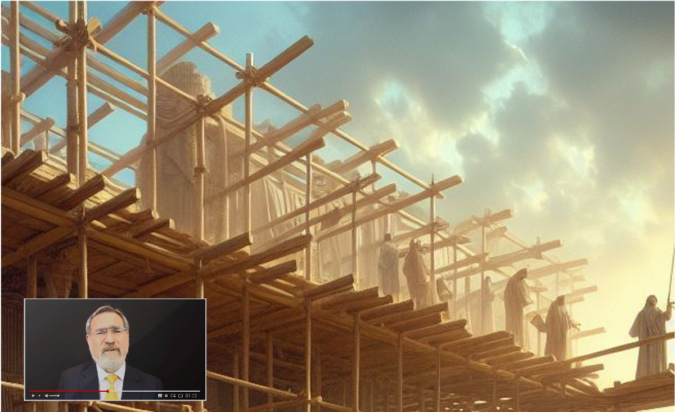

Ethics, Judaism, and AI: Can ChatGPT Strengthen Your Judaism?
Imagine if Cinderella were a panic-stricken college student, laboring at the last hour to compose a term paper on the portrayal of women in 19th-century literature.
Rabbi Sacks writes about Korach’s political perceptiveness in knowing exactly how to incite a rebellion. However, the rebellion could not have succeeded in any case, since the groups had different objectives.
Please follow the link below to the Sephardic University article on Sephardic Jews in the American Revolutionary War:
The spies feared success, not failure. This is the common mistake of deeply religious men. God wanted the Israelites to create a model society, where the Shechinah could become close to the people.
Rabbi Sacks writes about the challenges of leadership, such as those experienced by Moses in this week’s parashah, Beha’alotecha. Spiritual leadership is especially challenging. Moses called on God to kill him because he could not manage the weight of leadership.
Rabbi Bouskila remembers the brilliance and encyclopedic knowledge of his uncle Isaac, z/l.
Rabbi Barenblat’s Drash on Beha’alotecha is a few years old, but is surprisingly poignant and relevant. Rabbi Barenblat writes about the repetitive motif—the cloud, the journey, the waiting.
The parashah contains one of the most beautiful passages in the Torah; the Priestly Blessing. Rabbi Sacks,z/l, writes that we are all God’s children; God is everyone’s parent. God turns His face to us; He cares. Faith means that we believe in God’s love for us.
Rabbi Ruditsky describes the beauty of the Biblical chag of Shavuot as a time and place for connecting the earth, Israel, and God together. The later implementation by the rabbis brings out the holiness of receiving the Torah.
Bamidbar is read on the Shabbat before Shavuot; the two events are connected by the giving of Torah. Rabbi Sacks, z/l: writes that the Torah was given in desert so that it would not be “owned” by a specific place. In addition, it would be shared in a place of silence; to hear God we must have silence in our soul.